Every page on an addiction treatment website makes a medical claim. A detox page says what withdrawal feels like. An insurance page implies what care is covered. A blog post about Suboxone says something about how it works. Each of those claims will be read by someone in crisis, and each one is being judged by Google’s quality raters, by LegitScript, and eventually by a plaintiff’s attorney if the page is wrong.
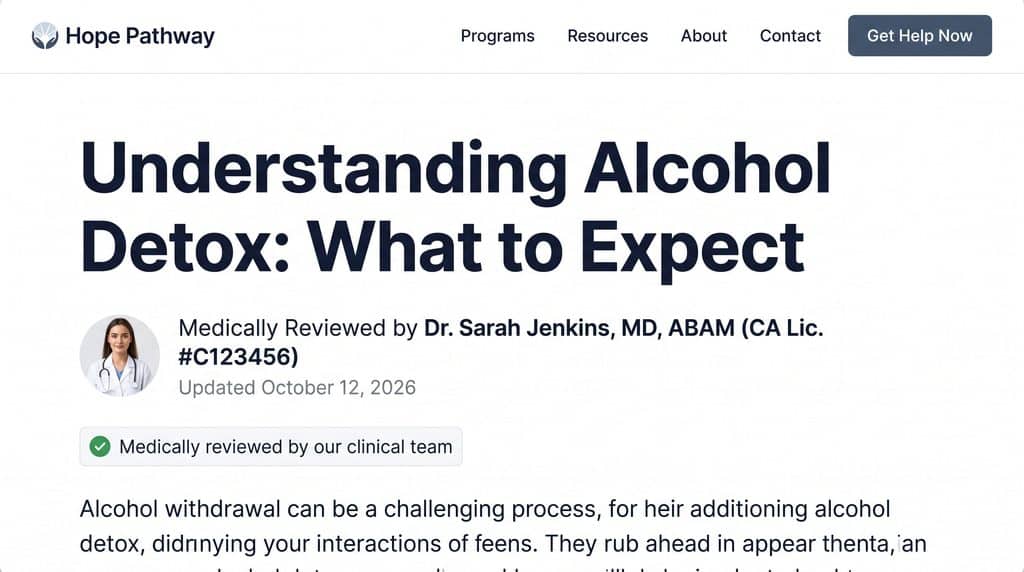
A medical review service is the layer between your writers and that exposure. A clinician reads the page, fixes what is wrong, and puts their name and license behind it. Done well, it is the single most visible E-E-A-T signal a treatment center can add. Done badly, it is a doctor’s headshot on a page nobody checked, which is worse than no badge at all because it is a claim you cannot back up.
This guide covers what to look for, what it should cost, and the questions that separate a real review network from a byline rental.
What a medical review service does, and what it doesn’t
The phrase “medical review” is used by three unrelated industries, so be clear about which one you are buying.
A Medical Review Officer (MRO) is a physician who verifies positive drug test results for employers. An independent medical examiner reviews injury claims for insurers. Neither has anything to do with your website.
A medical content review service assigns a licensed, practicing clinician to read health content before or after publication and certify that it reflects current clinical guidelines. For a treatment center, that means an addiction medicine physician, psychiatrist, pharmacist, or licensed counselor reading your pages the way a cautious colleague would: Is this accurate? Is anything missing that could get someone hurt? Would I sign this?
Credentialing: what actually matters
The value of a review rests entirely on who signed it. When a Google quality rater, a LegitScript auditor, or a reader clicks the reviewer’s name, the credential either holds up or the whole badge collapses.
Requirement What to verify Active license A licensed physician (MD or DO) for medical pages; NP, PA, PharmD, PhD/PsyD, LCSW, LPC, or LADC where the topic fits. Current license in a US state. Ask for the license number. Specialty match Addiction medicine, psychiatry, or emergency medicine for medical pages. Counseling credentials for therapy pages. PharmD for medication pages. NPI on file Every clinician who bills insurance has a National Provider Identifier. The listed taxonomy should match the bio. Clean record No disciplinary actions on the state board lookup. Active practice Still seeing patients. A reviewer who left clinical work five years ago is reviewing from memory. Public profile A page on the review service’s site, and on yours, listing all of the above plus a verification date.
Specialty matching for addiction and behavioral health
A general practitioner can competently review a page about seasonal allergies. They cannot competently review a page about phenobarbital tapers, naltrexone induction timing, or the difference between a PHP and an IOP under the ASAM criteria. Ask any service you are considering to show you the reviewers they would assign to your content, by name, before you sign.
For a typical treatment center library, the roster should cover:
- Addiction medicine or addiction psychiatry (board certified, or at minimum X-waiver era experience with MOUD) for detox, medication, and co-occurring disorder pages
- A PharmD for drug interaction, medication comparison, and “how long does X stay in your system” pages
- A licensed clinical social worker, professional counselor, or alcohol and drug counselor for therapy modality, family program, and aftercare pages
- A registered dietitian only for nutrition-in-recovery content, never for medical pages
- Psychiatry or psychology for mental health condition pages
A service that offers one physician for everything is offering a signature, not a review.
Where the reviewers come from
Ask whether reviewers are contracted directly by the service and vetted by it, or sourced from a freelance marketplace. Direct relationships mean the service knows who is reviewing, tracks license renewals, and can put the reviewer on a call with you. Marketplace sourcing means the name on your page may change without notice and nobody is checking whether the license is still active.
What a review should actually change
The fastest way to spot a rubber-stamp service is to look at the diff. A real review of a rehab page produces edits. If pages come back with a badge and no tracked changes, the clinician did not read it.
On addiction treatment content, a competent reviewer is checking:
- Withdrawal safety. Alcohol and benzodiazepine withdrawal can cause seizures and death. Any page that describes detox without saying so gets rewritten.
- Medication accuracy. Buprenorphine, methadone, and naltrexone are described correctly, with the “trading one addiction for another” framing removed.
- Levels of care. Detox, residential, PHP, IOP, and outpatient are defined the way ASAM defines them.
- Claims. Any success rate without a defined outcome, time frame, and source is removed. Any “cure” language is removed.
- Red flags. Overdose, suicidal ideation, and medical emergency guidance points to 911 or the 988 Lifeline, not to your admissions line.
- Citations. Claims link to clinical guidelines, systematic reviews, or peer-reviewed studies. Opinions are labeled as opinions.
- Scope. The page does not promise services the facility is not licensed to provide.
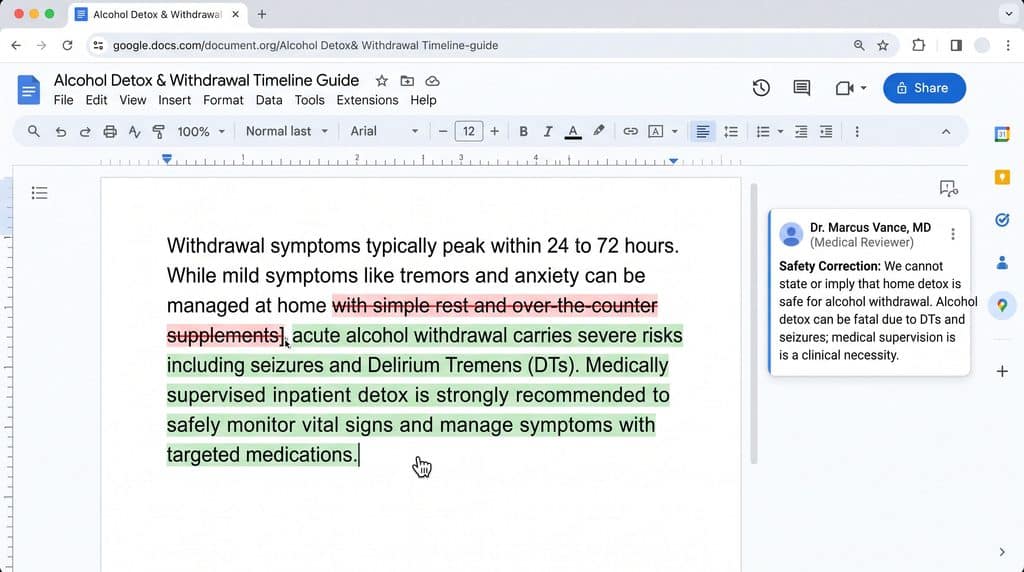
Ask for a redlined sample before you buy. If the service cannot show you one, you are buying a badge.
Turnaround times
Separate the SLA by review depth, not by page count. A uniform “48 hours for everything” promise means light pages are being over-billed and hard pages are being skimmed.
| Review type | What it covers | Turnaround |
|---|---|---|
| Light review | Short blog post or FAQ with no medication or detox content | 2 to 3 business days |
| Standard review | Service page, condition page, medication comparison | 5 business days |
| Deep review | Detox protocol pages, content for LegitScript submission, pages with cited studies | 7 to 10 business days |
| Re-review | Annual update or a guideline change on a page already reviewed | 2 to 3 business days |
Be skeptical of anything faster than a clinician could plausibly read the page. A physician with a full patient load is reviewing in the evening. A service promising same-day review on 40 pages is either not using clinicians or not reviewing.
Transparency and verification
A medical review only works as a trust signal if a stranger can verify it. The service should give you:
- A public reviewer profile page with name, credentials, license state, specialty, and a verification date
- A per-page byline with reviewer name and review date, linking to that profile
- Structured data support: the
reviewedByproperty on your Article or MedicalWebPage schema, pointing to a Person entity with their credentials - A record of what was reviewed and when, so you can prove the review happened if LegitScript or an attorney asks
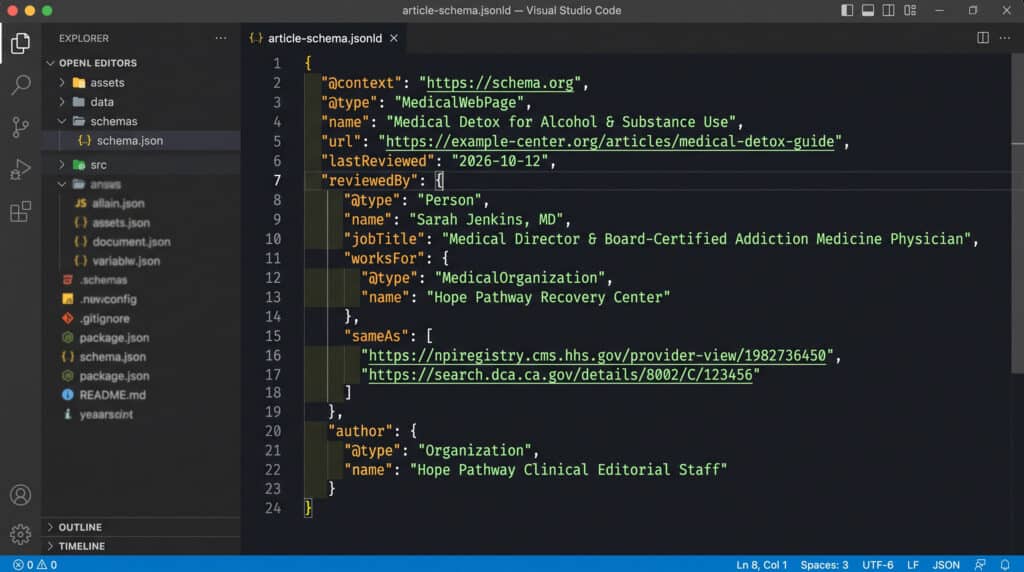
Review dates matter as much as names. Google’s guidance on YMYL content and LegitScript’s certification standards both expect content to be current. A review date from three years ago on a medication page tells readers and raters that nobody is maintaining it. Ask how the service handles re-review when guidelines change and whether that is included or billed again.
Workflow and integration
Your writers work in Google Docs or Word and publish to WordPress. The review service should fit into that, not replace it. Ask:
- Does the reviewer edit in the document with tracked changes, or send notes in a separate file?
- Can the service review in the CMS, or does everything round-trip through documents?
- How are the byline, the reviewer profile, and the schema delivered? Copy-paste, a plugin, or a snippet your developer adds once?
- What happens when a writer disagrees with an edit? Is there a path to a quick conversation with the reviewer, or is the edit final?
The last point matters more than it sounds. A marketing writer and an addiction physician will disagree about tone. A ten-minute call resolves what three rounds of comments cannot.
Pricing models and hidden costs
Medical content review is billed three ways:
Per page. A flat fee per reviewed page, usually tiered by depth. Predictable, easy to budget against a content calendar, and the right model for a center publishing a few pages a month.
Monthly retainer. A fixed fee for a page allowance plus re-reviews and profile maintenance. The right model for agencies managing several client sites or a center with a large legacy library to work through.
Per word. Common with marketplace services. Looks cheap until a 3,000-word pillar page costs more than the writer did.
The base rate is rarely the real cost. Watch for:
What you see What you pay Low per-page rate Rush fees for anything under a week “Unlimited reviewers” Specialty match surcharge when you actually need the psychiatrist One-time review fee Re-review billed in full when a guideline changes Byline included Schema, reviewer profile page, and verification date cost extra Reviewer assigned Reviewer changes without notice; you re-brief every time
The hidden cost of a bad service is not on the invoice. It is the LegitScript application that gets rejected, the page that gets demoted after a core update, or the detox page that told someone it was safe to stop drinking cold turkey.
Questions to ask before you sign
Clinical
- Who, by name, will review our detox and medication pages? Can we see their license number and NPI?
- Are your reviewers in active practice? How do you verify that?
- What happens when a reviewer’s license lapses or they get a board action?
- Can we see a redlined sample of a review on a page like ours?
Operational
- What is the turnaround by review depth, and what is the credit if you miss it?
- How many pages does a single reviewer handle per month?
- How do you handle a writer-reviewer disagreement?
- What is included for re-review when guidelines change?
Legal and reputational
- Do reviewers carry their own professional liability coverage?
- Who owns the review record if we leave?
- Has any content you reviewed been cited in a complaint, board action, or lawsuit? What happened?
Contract red flags
- Medically reviewed by our clinical team.” If there is no name, there is no review. Anonymous review is unverifiable and raters treat it that way.
- No license numbers on request. A legitimate reviewer has nothing to hide.
- One reviewer, every topic. A single physician certifying nutrition, therapy, medication, and detox pages is outside their scope on most of them.
- No edits. Pages return with a badge and no changes. The reviewer did not read it.
- Volume that doesn’t add up. A reviewer credited on hundreds of pages per month across dozens of sites is not reading them.
- Review record locked in. If you leave and lose the ability to prove which pages were reviewed and by whom, the badge was never yours.
- Evergreen auto-renewal with long notice periods. Ask for performance-based exit terms tied to turnaround and reviewer availability.
A medical review service is not a line item on the content budget. It is the difference between a treatment center website that can prove its pages are safe and one that is hoping nobody checks. Ask for names, ask for licenses, ask for the redlines, and walk away from anyone who won’t show you all three.
FAQs: Medical content reviewer vs. Medical Review Officer
Most of what Google returns for “medical review service” is about drug testing, not content. If you got here from one of those searches, or you are a treatment center whose patients ask about workplace drug tests, this section sorts it out.
What is a Medical Review Officer (MRO)?
Is a medical content reviewer the same thing?
Can an MRO review our website content?
Why should a treatment center care about MROs at all?
Which service should I be searching for?