Search for a drug rehab at two in the morning and you will see two kinds of trust badges. One site says every page is “Medically Reviewed by Dr. Jane Doe, MD.” Another cites a study “peer-reviewed in The Lancet” to back up its program. A third claims a 95 percent success rate and cites nothing at all.
The two badges are not the same thing, and neither one tells you whether a treatment center is any good. Peer review tells you a piece of research was checked by other researchers before it was published. Medical review tells you a clinician read a web page and agreed it reflects current practice. Knowing which one you are looking at, and how to verify it in about three minutes, is the difference between an informed decision and a sales pitch that happens to have a doctor’s name on it.
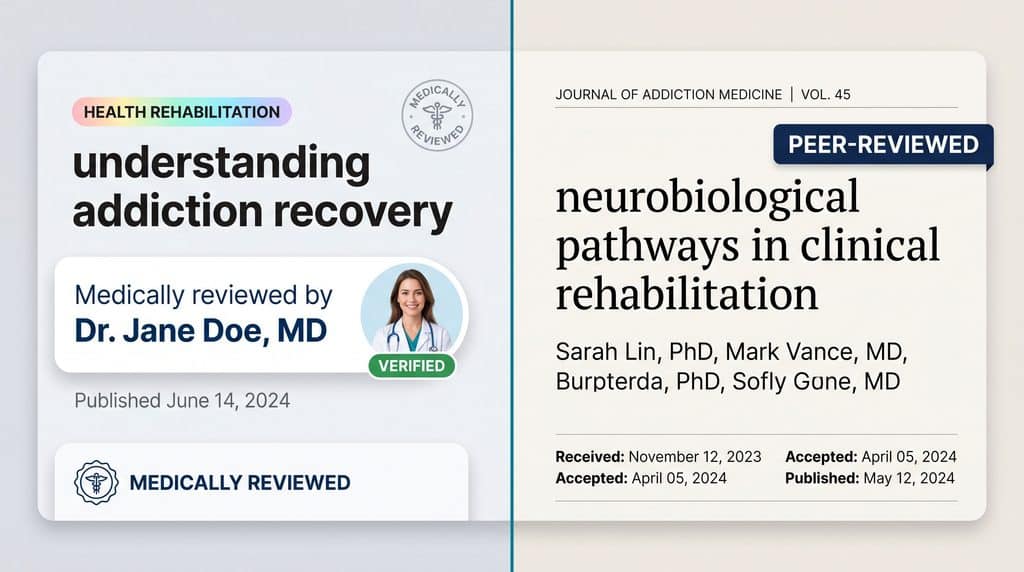
What peer review actually means
Peer review is the checkpoint between a researcher finishing a study and that study appearing in a medical journal. The researchers write up their methods and results, submit the manuscript to a refereed journal, and an editor sends it to independent specialists in the same field. Those reviewers are the authors’ peers. They are not paid by the authors and usually do not know them.
How the peer review process works
Reviewers are looking for reasons the study might be wrong. Was the sample big enough to mean anything? Did an ethics committee approve the protocol? If the study tested buprenorphine for opioid use disorder, did the researchers control for whether participants also got counseling, or housing, or had been in treatment before? Are the statistics appropriate for the data?
Manuscripts usually come back with revisions required: more analysis, softened conclusions, missing comparisons. Many are rejected outright. JAMA, one of the most selective journals in medicine, accepts about 10% of the more than 12,700 manuscripts it receives each year, and only 4% of the roughly 5,700 research papers. The process is slow. A 2019 study of general medical journals in Scientometrics found a median of 123 days from submission to acceptance and 224 days from submission to publication, with the slowest papers taking close to three years. A paper that gets through has cleared a real bar, but the bar is “the methods were sound,” not “this is settled medicine.”
What peer-reviewed research is good for, and where it stops
Peer-reviewed journals are where addiction medicine advances. Everything we know about why medications for opioid use disorder cut overdose deaths, why detoxing alone from alcohol or benzodiazepines can kill you, and why 28 days is not a magic number came out of this system. Readers can see the raw data, the dosages, the dropout rates, and the funding disclosures that reveal conflicts of interest.
The problem for a family trying to pick a rehab is that single studies are narrow by design. A trial showing one medication reduced cravings over twelve weeks in 200 people says nothing about whether the facility down the road uses it, or uses it well. Studies also contradict each other, and one result does not become clinical practice until it has been replicated and folded into a systematic review or clinical guidelines. If you treat one peer-reviewed article as a verdict, you will be whipsawed by the next one.
Peer review also cannot stop a published finding from being misused. In 1980, the New England Journal of Medicine ran a five-sentence letter from two Boston researchers reporting that, among more than 11,000 hospitalized patients given narcotics, only four developed addiction. The letter was accurate about what it measured: brief, supervised hospital use. It was then cited 608 times over the next 37 years, and 72% of those citations used it as evidence that long-term opioid therapy rarely caused addiction, something it never studied. Citations more than doubled after OxyContin launched in 1996. In 2017, NEJM took the unusual step of attaching a public warning to the letter, after a team of researchers traced how it had been “heavily and uncritically cited” and concluded the pattern helped shape the narrative behind the North American opioid crisis. The letter was never retracted. It did not need to be; it was true. Published is not the same as proven, and cited is not the same as understood.
What “medically reviewed” means on a rehab website
Medical review happens long after the research is published. It is quality assurance on the translation, not on the science.
How the medical review process works
A writer drafts a page: “What to expect during alcohol detox,” “Does insurance cover rehab,” “Suboxone vs. methadone.” The draft goes to a practicing clinician, usually an MD, DO, PharmD, nurse practitioner, or a licensed addiction counselor for non-medical topics. The reviewer is not re-running anyone’s statistics. They are asking whether the page matches current clinical guidelines and evidence-based medicine, whether the warnings are right, and whether anything on it could get someone hurt.
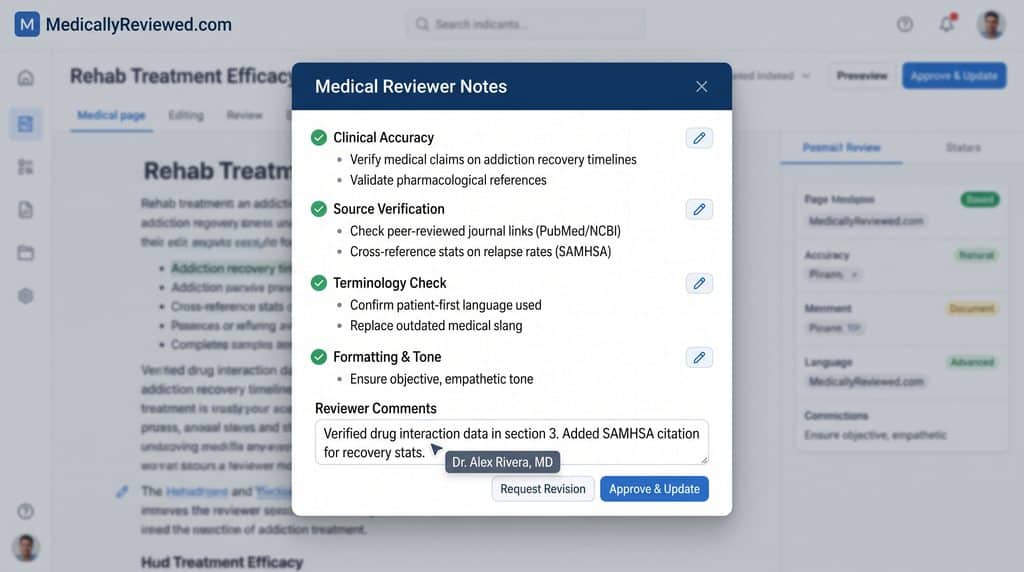
On an addiction treatment page specifically, a competent reviewer is checking things like:
- Withdrawal safety. Does the page tell readers that alcohol and benzodiazepine withdrawal can cause seizures and needs medical supervision, or does it describe detox like a spa stay?
- Medication accuracy. Are buprenorphine, methadone, and naltrexone described correctly, or does the page repeat the myth that medication is “trading one addiction for another”?
- Levels of care. Are detox, residential, PHP, IOP, and outpatient defined the way the ASAM criteria define them, or are they marketing labels?
- Claims. Any “success rate” without a definition of success, a time frame, and a source gets cut.
- Tone. Is the page reassuring without hiding the red flags that mean “go to the emergency room now”?
The reviewer’s signature means a healthcare professional read it and it reflects the standard of care. That is useful. It is also limited.
Where medical review falls short
The site publishing the page is usually a treatment center or a marketing company working for one. The business model rewards publishing fast and ranking high, and a reviewer can only flag what is on the page, not what the facility actually does once you arrive.
A medical review is also only as good as the match between the reviewer and the topic. A family physician reviewing a page about ketamine-assisted therapy for depression may miss things a psychiatrist would catch. A registered dietitian’s name on a page about opioid detox is a sign nobody checked the fit. And review dates matter: a page reviewed four years ago may still be describing treatment guidance that has since changed.
Not to be confused with hospital peer review
If you have searched this topic and landed on pages about the Joint Commission, utilization review, or the Health Care Quality Improvement Act, you have hit a third thing that shares the name. Hospitals and accredited treatment facilities run an internal process also called medical peer review, where other physicians evaluate a doctor’s cases after a bad outcome or complaint. It is governed by HCQIA, which gives reviewers legal protection and the physician under review due process rights, and it is tied to accreditation and patient safety requirements. It has nothing to do with journals or websites. It is worth knowing it exists, though: a facility that holds Joint Commission or CARF accreditation has agreed to run this kind of internal review, which is one more thing you can ask a rehab about.
The two badges side by side
Peer-reviewed research Medically reviewed content What it checks Whether a study’s methods and conclusions hold up Whether a web page matches current clinical practice Who checks it Independent researchers in the same field A practicing clinician, often paid by the publisher Written for Scientists, clinicians, students Patients, families, people in early recovery Strength Rigor, transparency, raw data Clarity, safety, practical next steps Weakness Narrow, slow, dense, not a verdict Simplified, commercially motivated, only as good as the reviewer Can be updated Only by retraction or a new paper Yes, and the review date tells you if it was
Which one to trust for which question
Use medically reviewed content when the question is practical: what detox feels like, how to talk to a loved one about treatment, what the difference between PHP and IOP is, how to check whether a plan covers residential care. A good reviewed page compresses the guidelines into something you can act on tonight.
Go to the peer-reviewed research when the stakes are specific and clinical: whether a particular medication is right for a particular situation, whether a treatment a facility is promoting (ibogaine, NAD+ infusions, “rapid detox”) has evidence behind it at all, or when standard treatment has failed and you and a physician are weighing options the consumer sites do not cover. A rehab that recommends a therapy and cannot point to a systematic review or a clinical guideline supporting it is telling you something.
For the biggest question, “is this facility any good,” neither badge answers it. That takes a phone call, questions about licensing and accreditation, and asking what percentage of patients who start treatment finish it.
How to verify a “medically reviewed” badge in three minutes
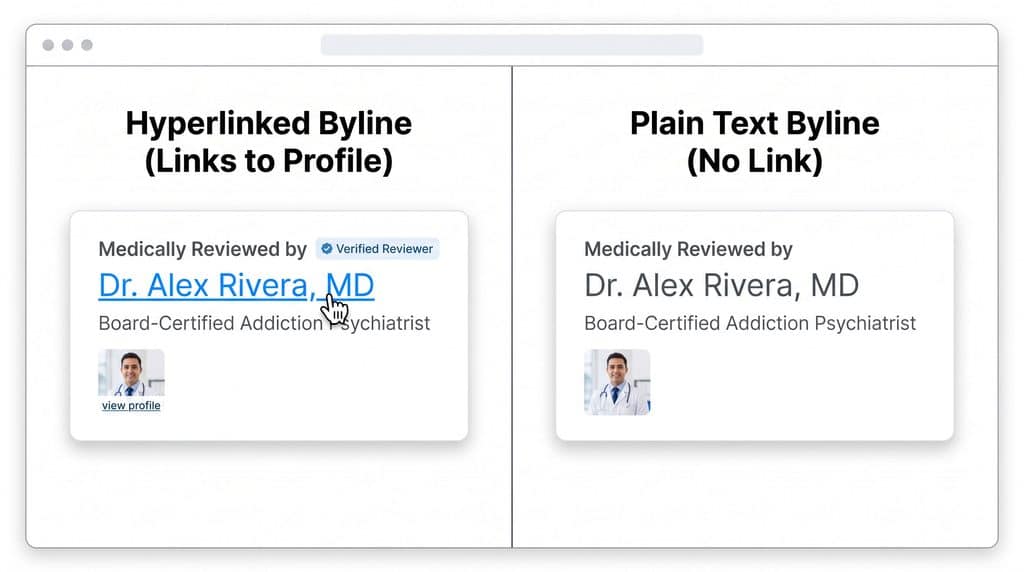
A badge is a claim. Here is how to check it.
- Click the reviewer’s name. If it does not link anywhere, or links to a bio with no credentials, stop there. Legitimate review programs publish who the reviewer is and what they are licensed in.
- Match the credential to the topic. An MD or DO with addiction medicine or psychiatry training for medical pages. An LCSW, LPC, or LADC for therapy and counseling pages. A PharmD for medication pages is a good sign. Anything that does not fit the subject is a flag.
- Look them up in the NPI Registry. Every US clinician who bills insurance has a National Provider Identifier. Search the name at npiregistry.cms.hhs.gov and confirm the specialty listed matches the bio.
- Check the state license. Every state medical and counseling board has a public lookup. Confirm the license is active and there are no disciplinary actions.
- Find the review date. If the page says “reviewed” but not when, treat it as unreviewed. If the date is more than two years old on a medication or treatment page, read it with that in mind.
- Look for citations. A reviewed page should link to the clinical guidelines, systematic reviews, or peer-reviewed articles behind its claims. A page with a doctor’s name and no sources is a page where a doctor approved opinions.
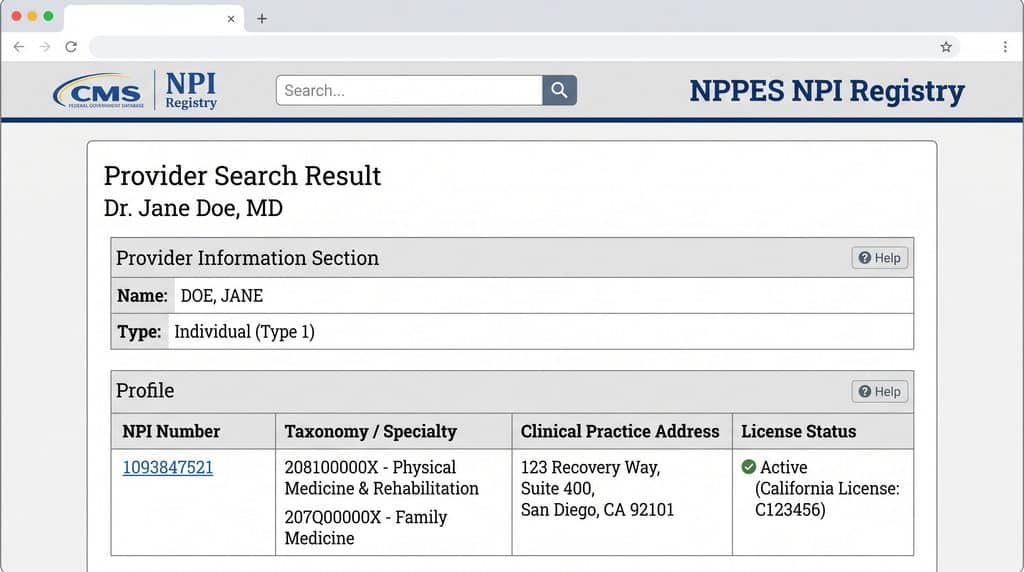
This is the standard MedicallyReviewed.com holds its own reviewers to, which is why every reviewer profile here lists the license, the specialty, and the verification date.
How to read a peer-reviewed addiction study without a medical degree
You do not need to understand the statistics to judge whether a study supports what a rehab is claiming.
- Check the study type. A randomized controlled trial in humans outranks an observational study, which outranks an animal study, which outranks a case report. A systematic review or meta-analysis that pools many trials is the most useful thing for a layperson to read.
- Check the sample. Forty people in one clinic is a pilot study, not proof.
- Check what was actually measured. “Retention in treatment at 30 days” and “abstinence at one year” are very different outcomes, and marketing copy routinely swaps one for the other.
- Check who paid. Funding disclosures and conflicts of interest are printed at the end of the paper for a reason.
- Check whether anyone replicated it. One trial is a lead. Three trials pointing the same way is evidence.
The short version
Peer review is how addiction science gets built. Medical review is how it gets translated for people who need to make a decision this week. Both can be faked or done badly, and both can be checked. Click the name, match the credential, look up the license, find the date, follow the citations. If a treatment center’s site cannot survive those five steps, the badge was decoration.